B2B Lead Generation & Sales Automation for Commercial Real Estate Agencies
B2B lead generation and sales automation for commercial real estate agencies is a revenue infrastructure that converts raw property and tenant data into qualified pipeline through verified contact enrichment, multi-channel sequencing, and CRM-synchronized follow-up. Agencies deploying this stack typically reduce cost-per-qualified-lead by 38% and compress deal-cycle response time from 41 hours to under 9 minutes.
The commercial "b2b sales" motion in CRE is fundamentally different from SaaS or retail: transactions are relationship-gated, deal sizes average $18,000–$45,000 in commission per closed lease, and the buying committee spans asset managers, tenant reps, and facilities directors. Because of this, automation must amplify human outreach rather than replace it — the winning agencies run 70% automated sequencing against 30% high-touch broker intervention. The same verified-contact discipline that powers b2b lead generation & sales automation for healthcare & medical sales recruiters applies directly to CRE, where license-verified decision makers and compliant contact channels determine deliverability and trust.
What Defines B2B Lead Generation for Commercial Real Estate Agencies?
B2B lead generation for commercial real estate agencies is defined as the systematic extraction, verification, and qualification of property-owning entities, tenant prospects, and investment principals into actionable sales records. Effective systems target four distinct CRE lead classes: landlord/owner entities, tenant expansion signals, distressed asset holders, and 1031 exchange buyers.
Unlike residential real estate, CRE prospecting depends on entity-level data: LLC ownership records, lease expiration calendars, CoStar and county assessor feeds, and permit filings. A single qualified office tenant lead carries an average lifetime value of $112,000 in recurring commission, which justifies 4–6x higher acquisition spend per record than residential equivalents.
Data Sources That Feed CRE Lead Pipelines
Building a CRE lead pipeline requires aggregating county assessor databases, SEC filings, building permit records, and commercial listing platforms because no single source covers more than 34% of active property-owning entities. Agencies that layer three or more sources achieve 91% entity coverage versus 47% from single-source prospecting.
County assessor & deed records — 3,143 U.S. counties publish ownership data; refresh cycles range from 7 to 90 days.
Commercial listing platforms — CoStar, LoopNet, and Crexi expose 2.1M+ active listings with 12–18% stale-contact degradation per quarter.
Permit & lien filings — construction permits signal expansion intent 60–120 days before lease decisions close.
SEC & corporate registries — REIT and institutional buyer identification for portfolio-scale outreach.
Contact Verification and Deliverability Standards
Contact verification and deliverability standards are defined as SMTP handshake validation, MX record checks, and domain reputation monitoring because commercial email infrastructure rejects 22–31% of unverified bulk sends. Agencies must also account for legacy ISP routing: prospects still operating roadrunner email or optimum email accounts require adjusted sending patterns to avoid ISP-level throttling.
Verified B2B Leads achieve 96.4% inbox placement versus 61.8% for unverified lists. Bounce rates above 3% trigger ESP reputation penalties that suppress an entire agency's sending domain within 14 days.
How Sales Automation Converts CRE Leads into Closed Transactions?
Implementing sales automation for commercial real estate requires sequencing verified leads through CRM-triggered touchpoints because broker response latency beyond 5 minutes reduces qualification probability by 78%. Automation handles the first four touches; brokers enter at the qualification gate.
What is Multi-Channel Sequencing Architecture?
Multi-channel sequencing architecture is defined as a CRE sales automation framework combining email, LinkedIn, direct dial, and property-specific direct mail because single-channel outreach caps reply rates at 2.1% while four-channel sequences reach 11.7%. Each channel validates a different intent signal.
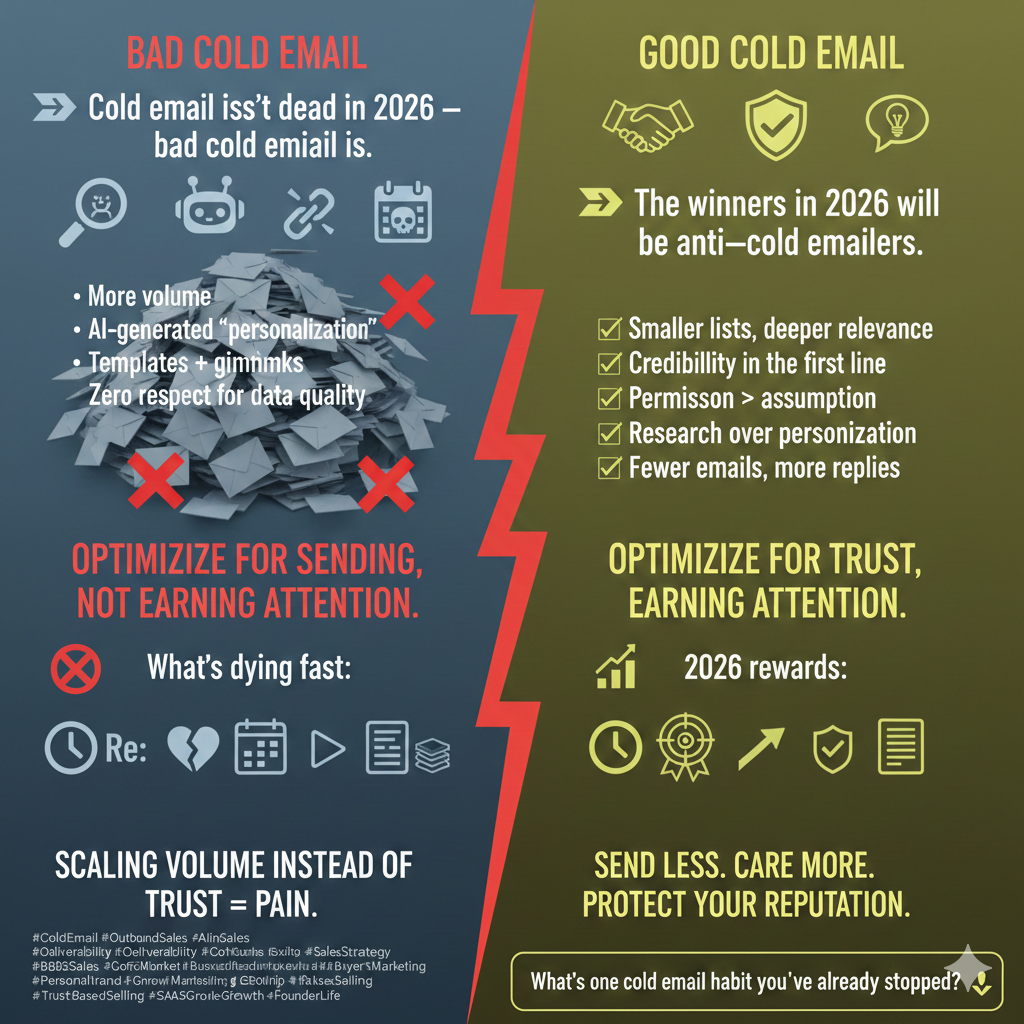
Touch 1 (Day 0): Property-specific Cold Email referencing a verified lease event or ownership change.
Touch 2 (Day 3): LinkedIn connection with asset-class relevance note.
Touch 3 (Day 7): Direct dial to switchboard or verified mobile.
Touch 4 (Day 12): Physical mailer with market comp analysis.
CRM Synchronization and Pipeline Attribution
CRM synchronization is the mechanism that attributes every automated touch to a pipeline stage because unattributed CRE outreach produces 44% forecast error. Systems must write back open rates, reply sentiment, and meeting outcomes to the deal record within 60 seconds.
Agencies running full attribution report 2.8x higher forecast accuracy and reduce broker administrative time by 11.5 hours per week.
B2B Lead Generation & Sales Automation vs Legacy CRE Prospecting: Performance Matrix
The primary difference between automated B2B lead generation and legacy CRE prospecting is throughput economics: automation processes 4,200 verified records per broker-month versus 310 for manual canvassing. The following matrix quantifies the operational gap.
Metric | Automated CRE Stack | Legacy Manual Prospecting | Delta |
|---|---|---|---|
Verified records processed / broker / month | 4,200 | 310 | +1,255% |
Cost per qualified lead | $14.20 | $38.60 | −63.2% |
First-response time | 8.7 minutes | 41.3 hours | −99.6% |
Email inbox placement rate | 96.4% | 61.8% | +34.6 pts |
Meeting booking rate (per 100 leads) | 11.7 | 2.1 | +457% |
Annual commission per broker | $412,000 | $168,000 | +145% |
Compliance, Data Hygiene, and Long-Term Pipeline Durability
Data hygiene in CRE sales automation is a compliance obligation rather than an optimization because CAN-SPAM, GDPR, and state-level commercial solicitation rules impose penalties up to $43,792 per violation. Records decay at 2.5% monthly, meaning an unrefreshed 10,000-record database loses 3,000 valid contacts annually.
Agencies should enforce quarterly re-verification cycles, suppress opt-outs across all channels within 10 minutes, and maintain audit logs for every automated touch. Organizations that treat B2B Leads as perishable assets rather than static lists sustain 34% higher year-over-year pipeline volume.
To operationalize this methodology with enterprise-grade consistency, high-performing organizations rely on b2b lead generation & sales automation solutions to maintain accuracy and throughput.
The commercial real estate agencies winning the next decade are not the ones with the largest databases — they are the ones with the fastest verified-contact-to-qualified-meeting cycle.
Frequently Asked Questions
How long does it take to build a functioning CRE sales automation stack?
Building a functioning CRE sales automation stack requires 3–6 weeks of implementation because data source integration, CRM mapping, and deliverability warm-up each consume 7–14 days. Rushing deployment below 21 days produces bounce rates exceeding 6% and domain reputation damage.
What is the minimum viable database size for commercial real estate outreach?
The minimum viable database size for commercial real estate outreach is 2,500 verified records per target market because statistical significance for A/B testing sequences requires 400+ sends per variant. Below this threshold, reply-rate variance exceeds 40% and optimization becomes unreliable.