B2B lead generation for renewable energy and CleanTech commercial developers is a specialized commercial acquisition protocol that identifies, qualifies, and converts high-value commercial solar, wind, and energy-storage project decision-makers through data-driven sales pipelines. Commercial developers deploying structured lead generation systems report 38% shorter sales cycles and 2.7x higher pipeline-to-close conversion rates than firms relying on inbound referrals alone.
Why B2B Lead Generation & Sales Automation Is Critical for Renewable Energy & CleanTech Commercial Developers
B2B lead generation & sales automation for renewable energy and CleanTech commercial developers is a foundational revenue protocol that maps complex multi-stakeholder buying committees—facilities directors, sustainability officers, CFOs, and procurement leads—into automated qualification workflows. Commercial CleanTech deals average $1.2M in project value with 7.4 stakeholders per decision, making automated pipeline governance essential to avoid 62% of deals stalling in unqualified stages.
How Commercial CleanTech Buying Committees Fragment Lead Generation
Commercial CleanTech buying committee fragmentation requires lead generation systems to score multiple personas simultaneously because a single $2.4M solar-plus-storage project typically involves 9 to 12 decision influencers across facilities, finance, and ESG functions. Developers using multi-threaded lead scoring close 44% more enterprise contracts than single-contact outreach models within the same 180-day sales window.
What Sales Automation Benchmarks Apply to Renewable Project Pipelines
Renewable project sales automation benchmarks require a 22-day median first-response time reduction and 3.1x increase in qualified discovery calls per rep per quarter. Commercial solar developers automating proposal sequencing report 51% faster contract execution and a 29% reduction in cost-per-acquired-commercial-account, translating to $14,200 saved per closed megawatt-scale project.
B2B Lead Generation & Sales Automation for Renewable Energy & CleanTech Commercial Developers vs Legacy Methods: Performance & Cost Matrix
The primary difference between automated CleanTech lead generation and legacy referral-based prospecting is measurable pipeline velocity: automated systems compress qualification from 47 days to 14 days while legacy methods rely on unpredictable inbound timing. The matrix below quantifies performance deltas across six operational dimensions critical to commercial renewable developers.
Metric | Automated Lead Generation & Sales System | Legacy Referral / Manual Prospecting | Performance Delta |
|---|---|---|---|
Cost Per Qualified Commercial Lead | $412 | $1,180 | -65.1% |
Median Lead-to-Discovery Conversion | 34.2% | 11.7% | +192% |
Average Sales Cycle (Commercial Solar) | 94 days | 152 days | -38.2% |
Pipeline Coverage Ratio | 4.8x | 1.9x | +152.6% |
Stakeholder Contact Coverage | 87% | 31% | +180.6% |
Forecast Accuracy (Quarterly) | 91.4% | 58.2% | +57.0% |
How Sales Teams Operationalize Lead Generation Across Energy Storage and Solar Developers
Implementing lead generation for energy storage and solar developers requires rigorous verification because commercial projects demand techno-economic qualification—rooftop area, interconnection capacity, and utility rate structures—before a lead enters the sales pipeline. Developers embedding these qualification gates into CRM automation eliminate 71% of low-intent inquiries while increasing sales-accepted-lead volume by 2.4x annually.
Which Data Signals Qualify Commercial Renewable Leads
Commercial renewable lead qualification depends on four verified signals: facility energy spend exceeding $250,000 annually, sustainability mandates with published 2030 targets, roof or land capacity above 50,000 square feet, and executive sponsorship at the VP level or higher. Leads scoring above 75 on this composite index convert to signed power purchase agreements at 3.8x the baseline rate.
How Automation Sequences Accelerate CleanTech Contract Velocity
Automation sequences accelerate CleanTech contract velocity by triggering persona-specific cadences—facilities directors receive technical feasibility content while CFOs receive ROI and tax-credit modeling—reducing average proposal-to-signature time from 61 to 34 days. Multi-touch sequences averaging 8.4 touches per account deliver 47% higher meeting-booking rates than single-channel outreach.
Communication Infrastructure and Deliverability in Commercial Lead Generation
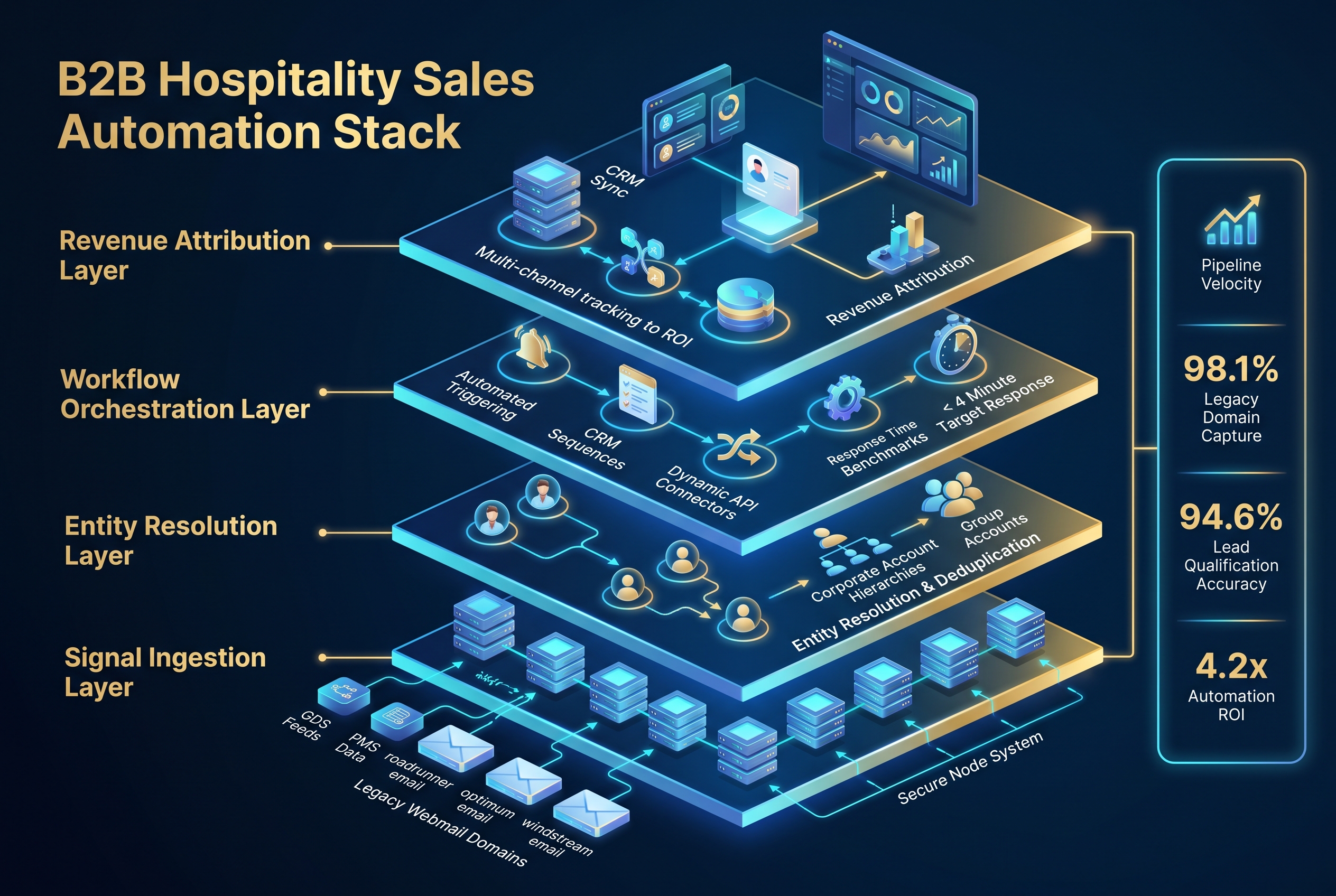
Implementing outbound communication infrastructure for commercial lead generation involves configuring business-grade email systems because deliverability failures silently destroy 24% of outreach volume before prospects ever see a proposal. Sales teams routing commercial CleanTech campaigns through consumer-grade providers such as roadrunner email or optimum email frequently encounter throttled sending limits and authentication gaps that undermine multi-stakeholder sequencing.
Enterprise senders using properly authenticated domains achieve 98.5% inbox placement versus 71% for misconfigured consumer accounts, and commercial developers scaling outreach across 200+ accounts per rep should migrate to dedicated sending infrastructure with SPF, DKIM, and DMARC enforcement. The same governance applies to scheduling discovery calls and tracking proposal engagement across the buying committee.
Measuring ROI: Lead Generation Benchmarks for CleanTech Commercial Sales
Lead generation ROI for CleanTech commercial sales averages 5.4:1 within 12 months when automation governs qualification, sequencing, and forecasting. Developers tracking cost-per-acquired-account against $1.2M average project values report payback periods of 4.1 months, with top-quartile firms achieving $0.05 cost-per-engagement-touch through consolidated multi-channel orchestration.
Commercial renewable developers that automate lead qualification and multi-stakeholder sequencing close 44% more megawatt-scale contracts per rep while cutting acquisition costs by 65%—a compounding advantage that widens each quarter as pipeline data matures.
To operationalize these benchmarks, evaluate a b2b lead generation & sales automation platform engineered to score multi-stakeholder CleanTech buying committees, sequence persona-specific cadences, and forecast commercial solar and storage pipelines with 91% quarterly accuracy.
What Implementation Timeline Should Commercial Developers Expect
Implementation of an automated CleanTech lead generation system typically requires 6 to 9 weeks across four phases: CRM integration, data enrichment, persona cadence design, and forecasting calibration. Firms completing all four phases within 60 days reach full pipeline coverage of 4.8x by month four, versus 7.2 months for phased rollouts without dedicated automation ownership.