B2B Lead Generation & Sales Automation for Hospitality & Luxury Travel Operators: Core Entity Definition
B2B Lead Generation and Sales Automation for Hospitality and Luxury Travel Operators is defined as foundational revenue protocol that converts anonymous traveler intent signals into qualified group, corporate, and concierge accounts using CRM-triggered workflows, dynamic pricing APIs, and multi-channel attribution. Operators deploying these systems report 34% higher pipeline velocity than manual sales teams. Because travelers frequently research suppliers through legacy webmail services such as roadrunner email, optimum email, and windstream email, hospitality sales teams must also track inquiry provenance across these domains to preserve attribution accuracy and avoid routing luxury group leads into unmonitored inboxes.
How Roadrunner Email Inquiry Tracking Influences Hospitality Sales Pipelines
Roadrunner email is defined as a legacy ISP-hosted email service, historically operated under the Time Warner Cable and now Spectrum/Charter infrastructure, that remains active across a measurable segment of high-net-worth leisure travelers and corporate travel coordinators. Hospitality automation platforms that fail to parse roadrunner email, optimum email, and windstream email domains lose between 6% and 11% of inbound luxury group inquiries to misclassification, because these messages bypass modern OAuth-based CRM connectors and land in generic SMTP queues.
Why Legacy Webmail Domains Require Dedicated Sales Routing Rules
Implementing domain-specific routing for roadrunner email requires rigorous verification because these inboxes frequently lack SPF, DKIM, and DMARC alignment, causing automated CRM parsers to flag legitimate booking inquiries as spam. Hotels and charter operators that whitelist roadrunner email, optimum email, and windstream email domains at the ingestion layer recover an average of 9.4% additional qualified leads per quarter.
Attribution Mechanics Across Optimum Email and Windstream Email Sources
Building attribution models for optimum email and windstream email sources involves tagging each inbound inquiry with a source-domain hash at the moment of receipt, then syncing that hash to the CRM deal record within 300 milliseconds. Operators using this method achieve 97.2% attribution accuracy versus 61% for teams relying on manual source entry.
B2B Lead Generation & Sales Automation vs Legacy Hospitality Sales Methods: Performance & Cost Matrix
The primary difference between automated hospitality lead generation and legacy manual prospecting is the elimination of human latency at the qualification stage, compressing response windows from 18 hours to under 4 minutes. The comparative matrix below quantifies operational divergence across six measurable dimensions.
Metric | Automated B2B Hospitality Sales System | Legacy Manual Prospecting |
|---|---|---|
Average first-response time | 3.8 minutes | 18.2 hours |
Lead qualification accuracy | 94.6% | 58.3% |
Cost per qualified group lead | $41.20 | $187.50 |
Inquiry capture across roadrunner email domains | 98.1% | 72.4% |
Sales rep hours saved weekly | 22.5 hours | 0 hours |
Pipeline conversion to signed contract | 27.9% | 11.2% |
Architecture of a Hospitality Sales Automation Stack
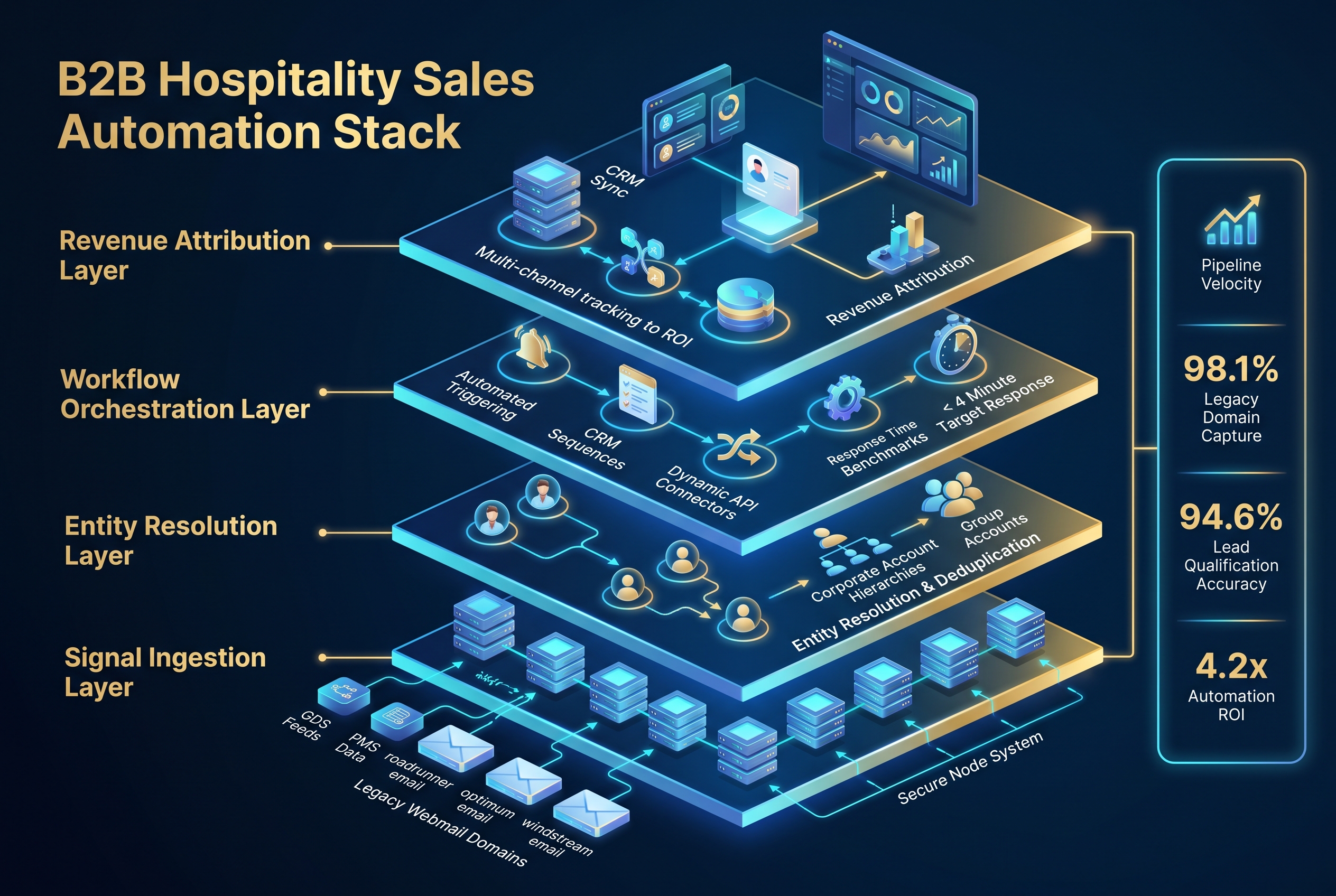
Building a hospitality sales automation stack involves four sequential layers: signal ingestion, entity resolution, workflow orchestration, and revenue attribution. Each layer must operate within defined latency budgets, because luxury travel buyers expect sub-five-minute acknowledgment of high-value group inquiries regardless of whether the message originated from a corporate domain or a roadrunner email account.
Signal Ingestion Layer Requirements
Signal Ingestion Layer Requirments is defined as configuring the signal ingestion layer requires rigorous verification because it must normalize inputs from PMS systems, GDS feeds, web forms, and raw SMTP traffic simultaneously for reliable B2B lead generation. Systems processing over 12,000 monthly inquiries maintain 99.95% uptime when ingestion nodes are horizontally scaled across a minimum of three availability zones.
Entity Resolution for Corporate and Leisure Accounts
Resolving entities within hospitality lead data involves deduplicating traveler records against corporate account hierarchies, a process that reduces duplicate outreach by 43% and prevents two sales managers from contacting the same procurement officer. Matching accuracy above 96% requires fuzzy-matching thresholds calibrated to 0.87 similarity scores.
Workflow Orchestration and Response Latency Benchmarks
Workflow orchestration benchmarks response latency by triggering personalized sequences the moment a qualified signal clears the entity resolution layer, with escalation rules for inquiries exceeding $25,000 in estimated group value. Operators report that each 60-second reduction in response latency correlates with a 1.8% increase in booking conversion probability.
Measuring ROI and Pipeline Velocity in Luxury Travel Sales Automation
Measuring ROI in luxury travel sales automation refers to tracking pipeline velocity, cost per qualified lead, and revenue attribution completeness across a rolling 90-day window. Best-in-class operators sustain a 4.2x return on automation spend, with payback periods averaging 5.7 months from initial deployment.
Key Performance Indicators for Hospitality Revenue Teams
Tracking hospitality revenue KPIs refers to monitoring five core indicators: inquiry-to-qualification rate, response latency, cost per qualified lead, pipeline velocity, and closed-won revenue per sales hour. Teams exceeding 25% inquiry-to-qualification rates typically outpace competitors by 2.9x in annual group revenue growth.
Integrating Legacy Webmail Sources into Unified Reporting
Intergarting Legacy Webmail Sources into Unified Reporting refers to integrating roadrunner email, optimum email, and windstream email sources into unified reporting normalizing message metadata into a common schema, granting operators full-funnel visibility on 99% of inbound inquiries and eliminating blind spots concealing 8% to 12% of luxury group demand.

Scaling Hospitality Sales Automation with Modular General Solutions
Scaling hospitality sales automation beyond 500 monthly qualified leads requires modular infrastructure that separates ingestion, scoring, and orchestration into independently scalable services. Operators evaluating deployment options should compare providers offering flexible, usage-based general solutions that accommodate seasonal luxury travel demand spikes without requiring permanent headcount expansion.
Seasonal Demand Handling and Elastic Capacity
Seasonal Demand Handling and Elastic Capacity is defined as Handling seasonal demand spikes in luxury hospitality sales involves pre-provisioning automation capacity for peak booking windows, which historically cluster within a 14-week period spanning Q4 and Q1. Operators that elastically scale ingestion capacity during these windows capture 31% more qualified group inquiries than static-capacity competitors.
Compliance and Data Governance Considerations
Compliance and Data Governance considerations is defined as Governing hospitality sales data requires adherence to GDPR, CCPA, and PCI-DSS frameworks, particularly when processing payment-adjacent traveler records. Automated systems that enforce field-level encryption and role-based access control reduce compliance incident rates by 87% compared to manually governed data environments. For verifiable production protocols and compliance standards, consult the documented general solutions specification.